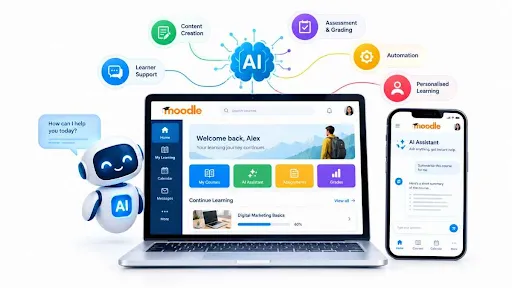
AI has become a reality. It is evident in the learning, writing and planning tools people use. These capabilities are made accessible to online classrooms easily with the help of the integration of Moodle AI. If used well it can save efforts, help learners and uncover helpful patterns. It can be misleading when not used properly, in terms of fairness and privacy. The article details five aspects of how to think about and use Moodle AI integration within a learning platform.
There are many hours spent preparing a course. AI can take a bit of that burden by providing ideas for quiz questions, lesson summaries, and activity ideas. A teacher can ask ten practice questions on a topic and then edit them to suit the class. This turns a blank page into a starting point. It also saves time for more useful things to be done like providing feedback or discussion with students. Each piece of created content, though, should be run through a verification process as well for content, tone, and relevance. While Moodle AI Solutions can be rapid, it's only a careful teacher who can assure the right, clear and actually helpful information.
Learners may have questions that come up outside of class time when there is no teacher present. A chat style assistant can answer common questions anytime, for example, the location of the deadline, and how to submit work, along with what a term means. Responses come within seconds, keeping pupils from getting bogged down. Staff also have a reduction in the number of questions they need to answer. But these kinds of helpers have their limitations. They may misinterpret a request and provide partial answers. Learners know that clear instructions, trusted course materials, and an accessible method for contacting a real person will ensure that they get a truly helpful, friendly and reliable experience.
A lot of information is gathered by learning platforms, but most of it is hard to read and people don't have the time to study it all. Moodle AI solution can review this information and identify what's important, like students who aren't logging in, subjects where a lot of answers are incorrect, and activities that no one completes. Such signals enable teachers to act while waiting for it. A little encouragement can make a big difference for a poor performer. Only numbers will not convey the full picture. They need to be understood in the context and with some human understanding. With good use, insights can be a guide for support, not an assessment of someone.
Moodle AI solutions need to be used responsibly because it is the foundation of all learning spaces. Learners should be familiar with the purpose of using AI, when it is being used, and what information it’s using. Personal information should be well protected and not shared unless absolutely necessary. Another issue is the possibility of bias, as automated tools could be based on unfair patterns from their training. Such issues can be detected through regular reviews. Most importantly, it is important that the decisions concerning grades, progress and behavior remain with people.
Moodle AI solutions LMS within a learning platform isn't a teacher, it's a tool. It will be able to tailor lessons, save time, respond to questions, and provide valuable patterns. It is dependent on proper direction. Set small targets, safeguard learner data and maintain a human touch. The shift from technology to teaching is an ongoing process that leads to more supportive, efficient, and rewarding online learning.

This post has been authored and published by one of our premium contributors, who are experts in their fields. They bring high-quality, well-researched content that adds significant value to our platform.


Your go-to source for news, lifestyle, culture, tech, and more. Fresh updates daily, stay informed always.
Email: contact@thedailylondon.com