Time duration is simply the amount of time between a starting point and an ending point. Whether you are tracking work hours, planning an event, calculating study time, or measuring the length of a project, knowing how to calculate duration accurately can save time and prevent mistakes.
Fortunately, calculating time duration does not have to be complicated. You can use a simple formula for manual calculations or an online time duration calculator to get results quickly.
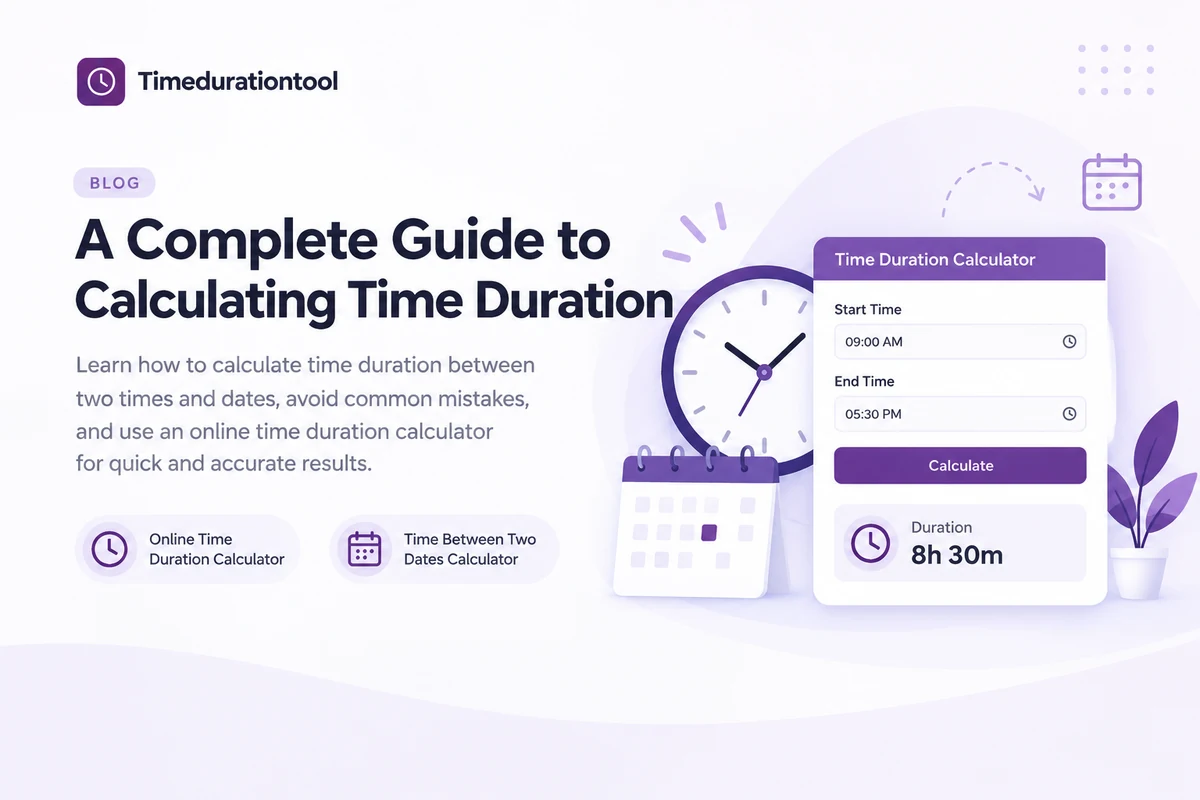
Time duration represents the elapsed time between two points. For example, if you start working at 9:00 AM and finish at 5:00 PM, the duration is 8 hours, assuming there is no break.
Time duration can be expressed in:
The method you use depends on whether you are calculating a few hours or a period that spans several days.
The basic method is to subtract the start time from the end time.
Formula:
Time Duration = End Time − Start Time
For example, suppose you start studying at 2:15 PM and finish at 5:45 PM.
For straightforward calculations like this, manual subtraction works well.
When both times occur on the same day, simply compare the hours and minutes.
Start time: 8:30 AM
End time: 2:00 PM
From 8:30 AM to 12:30 PM = 4 hours
From 12:30 PM to 2:00 PM = 1 hour 30 minutes
Total duration = 5 hours 30 minutes
This approach is useful for work shifts, appointments, classes, meetings, and other daily activities.
Calculating duration becomes slightly different when the end time falls on the following day.
For example:
Start: 10:00 PM
End: 6:00 AM
From 10:00 PM to midnight = 2 hours
From midnight to 6:00 AM = 6 hours
Total duration = 8 hours
Instead of simply subtracting the two clock times, divide the calculation at midnight.
Manual calculations are fine for simple examples, but they can become inconvenient when seconds, overnight periods, or multiple calculations are involved.
An online time duration calculator allows you to enter a start time and an end time and receive the duration automatically. Depending on the tool, the result may be displayed in hours, minutes, seconds, or decimal hours.
These calculators can be particularly useful for:
They also reduce the chance of mistakes caused by manual time subtraction.
When you need to calculate a period longer than a single day, you need to consider both the dates and times.
For example:
Start: January 10 at 9:00 AM
End: January 12 at 3:00 PM
The period includes two complete days plus six additional hours.
A Time Between Two Dates Calculator can make these calculations easier by automatically determining the total difference between the selected dates and times.
This is useful for project deadlines, vacations, subscriptions, age calculations, event planning, and other date-based calculations.
Sometimes time needs to be represented as a decimal instead of hours and minutes.
For example:
2 hours 30 minutes
Since 30 minutes equals 0.5 hours:
2 hours 30 minutes = 2.5 hours
Another example:
7 hours 15 minutes = 7.25 hours
The formula is:
Decimal Hours = Hours + (Minutes ÷ 60)
This format is especially useful for payroll, invoices, timesheets, and project billing.
A few common mistakes can lead to incorrect results:
Always check whether the start and end times are in the morning or afternoon. Confusing AM with PM can completely change the result.
If a shift continues past midnight, treat midnight as the transition between two dates.
Remember that 60 minutes = 1 hour. For decimal calculations, divide minutes by 60 rather than treating them as a decimal directly.
For work-hour calculations, subtract unpaid breaks when calculating the actual working duration.
Accurate duration calculations are important in many everyday and professional situations. Businesses use them to track employee hours and calculate payroll, while freelancers may use duration to determine project billing.
Students can calculate study sessions, travelers can measure journey times, and individuals can use duration calculations to plan their daily schedules more effectively.
Calculating time duration is easy when the start and end times are simple, but longer periods, overnight shifts, and decimal conversions can make manual calculations more challenging. Understanding the basic formula gives you a solid foundation, while an online time duration calculator can provide quick and convenient results.
For calculations involving multiple dates, a Time Between Two Dates Calculator can also simplify the process and help you determine the exact length of a period.

This post has been authored and published by one of our premium contributors, who are experts in their fields. They bring high-quality, well-researched content that adds significant value to our platform.


Your go-to source for news, lifestyle, culture, tech, and more. Fresh updates daily, stay informed always.
Email: contact@thedailylondon.com