Few events move financial markets like a central bank rate decision. In a single afternoon, a quiet sideways market can turn into a powerful trend. Equally, a strong rally can stall and drift into a choppy range.
After more than two decades of watching traders react to these moments, one lesson stands out. The traders who last are not the ones who predict every decision. Instead, they are the ones who notice when market regimes in trading have changed, and then respond with discipline.
This guide explains how interest rate decisions reshape market behavior. It also shows how to identify the new regime and how to adapt trading strategy to market conditions without guesswork.
A market regime is the dominant behavior of price over a period of time. Put simply, it describes the personality of the market. Some periods are calm and orderly, while others are fast, volatile, and directional.
Most analysts group market regimes in trading into four broad types:
These categories often overlap. For example, a market can trend quietly, or it can range with wild swings. Even so, the split between trending vs range-bound markets is the foundation of regime analysis. A strategy that thrives in one regime often struggles in the other, which is why regime awareness matters so much.
Interest rates are, in essence, the price of money. When a central bank such as the Federal Reserve, the European Central Bank, or the Bank of England changes its policy rate, borrowing costs change across the whole economy. As a result, the effects ripple through every asset class.
Higher rates generally make borrowing more expensive. Consequently, companies may slow expansion, and consumers may spend less. Future earnings are also discounted more heavily, which weighs on asset prices. Lower rates tend to do the opposite. They encourage borrowing, support valuations, and push investors toward riskier assets in search of yield.
However, the decision itself is only part of the story. Markets look ahead, so much of the expected move is already priced in before the announcement. What truly shifts market regimes in trading is the gap between what traders expected and what the central bank delivers. In addition, the tone of the statement, the press conference, and updated economic projections all carry weight.
Rate decisions can push markets from one regime into another in several ways. Below are the most common patterns seen across many policy cycles.
When a central bank delivers an unexpected move, markets must reprice quickly. For instance, a surprise hike can turn a slow equity uptrend into a sharp decline. Similarly, currencies can break out of months-long ranges within minutes. These surprises often mark the start of a new trending regime. That is because large institutions need days or even weeks to rebalance their positions.
Sometimes the rate stays the same, yet the market still moves sharply. This usually happens because the central bank changes its forward guidance. For example, a shift from patient language to watchful language signals that policy may tighten. In turn, bond yields rise, and the currency may begin a sustained trend. In many cases, guidance is watched more closely than the rate itself.
The most powerful shifts in market regimes in trading often happen at policy pivots. A pivot is the moment a central bank stops hiking and signals cuts, or the reverse. Historically, pivots have ended long trends and started new ones. For example, the end of a hiking cycle has often lifted equities out of a bearish phase and into recovery.
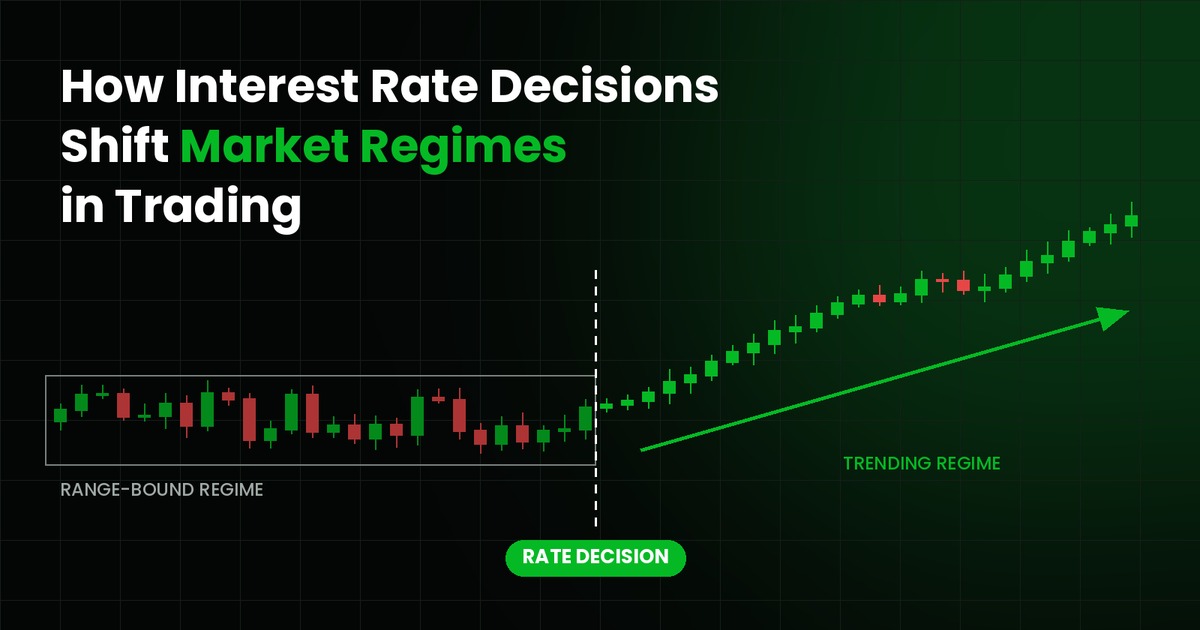
Before a major decision, markets often go quiet. Traders cut position sizes and wait, which creates a compressed, range-bound environment. After the announcement, volatility typically expands. If the outcome is decisive, that expansion can grow into a new trend. On the other hand, if the outcome is mixed, price may whipsaw and then settle back into a range.
Each asset class responds to policy changes in its own way. Understanding these reactions helps traders anticipate which regime may follow.
Currencies. Forex markets are highly sensitive to interest rate gaps between countries. When one central bank raises rates while another holds, capital tends to flow toward the higher-yielding currency. As a result, extended trends can form and last for months.
Equities. Stock markets generally prefer lower rates. Growth and technology stocks are especially sensitive, because their valuations depend on earnings far in the future. Therefore, hawkish surprises often hit these sectors first.
Bonds. Bond prices move in the opposite direction to yields. A hawkish shift usually pushes yields higher and bond prices lower. Moreover, bond market trends often lead other markets, so they can serve as an early warning signal.
Gold and commodities. Gold tends to struggle when real interest rates rise, since it pays no yield. By contrast, it often benefits when rates are cut or when policy uncertainty rises.
Crypto. Digital assets have increasingly traded like other risk assets. Looser policy has often supported crypto rallies, whereas aggressive tightening has coincided with deep drawdowns.
Telling trending vs range-bound markets apart quickly is one of the most valuable skills a trader can build. After a rate announcement, the first hour of price action is often noisy. For that reason, experienced traders wait for confirmation before drawing conclusions.
Signs that a new trending regime is forming include:
Signs that the market is staying range-bound include:
It is worth noting that a regime can only be confirmed over time. A single candle rarely tells the full story. Instead, look for a cluster of signals that point the same way before you treat market regimes in trading as settled.
Knowing the regime is only useful if it changes how you trade. In fact, the ability to adapt trading strategy to market conditions is what separates consistent traders from those who give back their gains. Here are practical steps drawn from years in the markets.
Trend-following tools, such as moving average crossovers and breakout systems, perform best in trending phases. In contrast, mean-reversion tools, such as oscillators and support-and-resistance fades, work better in ranges. Using the wrong tool in the wrong regime is one of the most common causes of losses.
Volatility often spikes during and after rate decisions. Consequently, spreads can widen and slippage can increase. Trimming position size before the event helps keep risk under control. Many professionals simply stay flat until the first reaction settles.
Stop-loss levels should reflect current conditions. In high-volatility regimes, tight stops are often hit by normal noise. Meanwhile, in quiet regimes, wide stops may expose you to needless risk. A volatility measure such as the Average True Range (ATR) can help you set sensible distances.
Rate decisions are scheduled well in advance, so there is no reason to be caught off guard. Know when each major central bank meets. In addition, watch related data such as inflation reports and jobs figures, since they shape expectations ahead of each meeting.
Markets do not stay in one regime forever. A trend that began after a hawkish surprise may fade once the news is fully absorbed. For this reason, review the regime each week and adapt trading strategy to market conditions whenever the evidence changes.
Even skilled traders fall into predictable traps on policy days. Being aware of them can prevent costly errors.
First, many traders react to the headline instead of the full message. The initial move is often reversed once the statement and press conference are digested. Second, some traders assume the old regime will simply continue. A strategy that worked for months can fail abruptly after a pivot. Third, traders often ignore the wider policy cycle. A single cut within a long tightening phase may not signal a new trend at all. Finally, heavy leverage during volatile periods can erase weeks of progress in minutes.
A clear routine brings structure to what is often an emotional day. Over time, it builds discipline and reduces impulsive choices.
Following these steps also makes it easier to track how market regimes in trading evolve from one meeting to the next.
Interest rate decisions are among the most reliable catalysts for change in financial markets. They can end long trends, start new ones, or trap price in extended ranges. Understanding how market regimes in trading respond to these shifts gives you a real edge.
Rather than trying to predict every outcome, focus on three things. Identify the current regime, confirm any change with evidence, and adjust your approach to match. Many traders also use regime-aware indicators to support this process, and it is natural to research any tool before relying on it. For instance, traders exploring GainzAlgo often ask "is GainzAlgo legit" before testing its trend and range signals. That kind of careful review is healthy, because any indicator works best alongside sound risk management and your own analysis.

This post has been authored and published by one of our premium contributors, who are experts in their fields. They bring high-quality, well-researched content that adds significant value to our platform.


Your go-to source for news, lifestyle, culture, tech, and more. Fresh updates daily, stay informed always.
Email: contact@thedailylondon.com