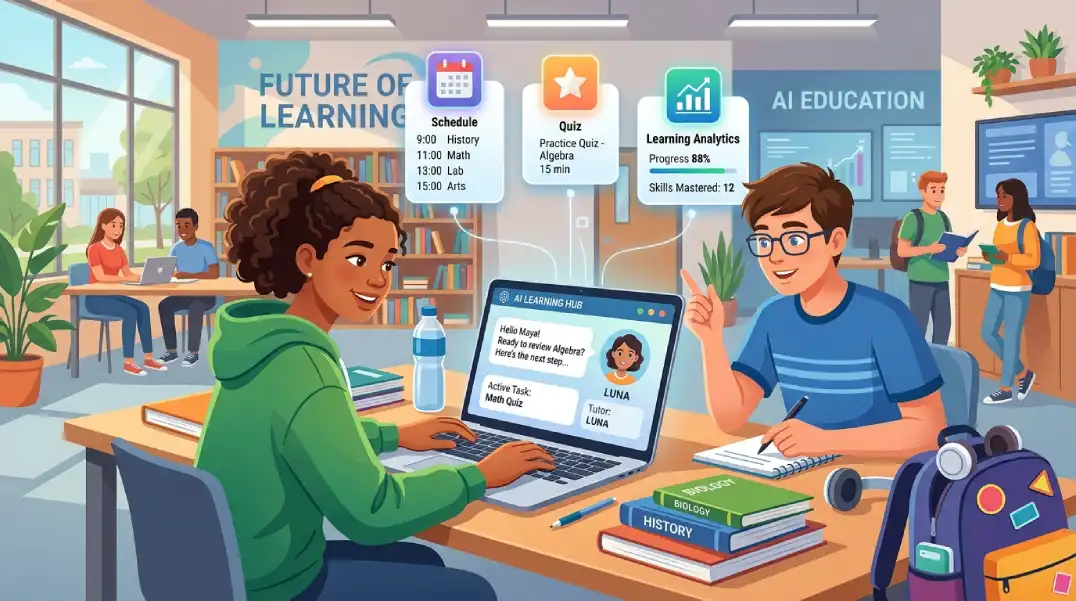
Back to school preparation looks different in the age of artificial intelligence. Students no longer rely only on paper planners, printed textbooks, and last-minute revision sessions. AI-powered tools now assist with planning study schedules, generating quizzes, and reviewing complex topics.
The purpose of this article is to explain how AI in schools is influencing the way students prepare for a new academic term. Many students now use AI for planning, practice questions, and targeted review. At the same time, concerns remain about overreliance on automated answers and reduced independent thinking.
The discussion focuses on practical examples. Readers will learn how AI tools support daily preparation, how students can manage time more effectively, and why simple offline habits remain important for real learning.
The article provides short checklists and practical examples. Parents, teachers, and students will see one clear step for safely testing an AI study tool during a normal school week.
How AI tools change everyday student preparation
Artificial intelligence now assists students with several daily learning tasks. Common tools include smart scheduling applications, AI study assistants, automated quiz generators, and personalized review reminders.
These systems analyze course materials and suggest structured study plans. A tool may scan a syllabus, detect upcoming deadlines, and recommend when each topic should be studied. Many tools convert lecture notes into practice questions or short summaries.
Students often use AI to divide large assignments into manageable sessions. For example, a student studying a ten-chapter unit can receive a schedule that spreads the material across fourteen days with 30-minute study blocks.
AI systems can also identify weak areas. When a student answers several questions incorrectly, the system recommends additional practice on that topic.
However, tools may produce simplified explanations or incomplete summaries. Overreliance may reduce deep understanding. A practical method helps prevent this problem.
Active practice confirms whether the concept is truly understood.
AI scheduling tools support structured time management. These tools identify natural study periods and automatically assign learning blocks to those times.
Three common benefits appear when students test a smart schedule.
A simple one-week test demonstrates whether the system works effectively.
Steps for testing an AI scheduler:
Calendars cannot force concentration. A planner organizes time but does not guarantee focus. Students must still commit to the scheduled sessions.
A structured study block helps students stay productive. The following template works with or without an AI app.
45-minute focused study block
Each step serves a specific purpose.
Students gearing up for school days start by organizing supplies alongside their study schedules. Durable school bags for boys and girls keeps books, notebooks, and gadgets neatly in place, making it easier to handle everything from class to homework. This smart choice supports both digital tools and classic learning routines without the hassle.
Progress tracking can occur in a simple notebook or in a study application. Both methods produce useful feedback.
Balancing AI with simple offline habits that matter
Technology can support learning. Core academic habits still shape long-term understanding. Research from organizations such as the OECD and UNESCO shows that effective learning requires active engagement rather than passive information consumption.
Several offline habits continue to support academic success.
Handwritten notes strengthen memory because the brain processes information during writing. Students summarize ideas rather than copying text.
AI tools can support these habits rather than replace them. For example, an AI tutor may identify weak topics in mathematics. A student can then practice those problems manually or review them with a study partner.
Before adopting a new AI tool, students and parents can review a simple evaluation checklist.
AI tool evaluation checklist
Setting clear limits prevents overdependence on automated answers.
A practical boundary supports balanced learning. Students can limit AI use to three structured tasks:
At least one daily offline activity should remain unchanged. Writing one key concept by hand or explaining the concept to a friend strengthens comprehension.
Additional resources that discuss technology integration in education can be reviewed through educational platforms such as https://www.sciencedirect.com/science/article/pii/S2666412722000137, which explains responsible digital learning strategies.
Setting healthy boundaries and teacher collaboration
Responsible using AI in the classroom requires collaboration between students and teachers. Clear guidelines ensure that technology improves preparation without weakening academic integrity.
Teachers increasingly define assignments that restrict AI assistance. These tasks require original analysis, handwritten summaries, or in-class problem solving.
Students can still use AI tools for preparation outside those assignments. A useful strategy treats AI suggestions as hypotheses rather than final answers.
A structured workflow often improves results.
This method prevents misunderstanding while still benefiting from automated planning.
A short example illustrates this approach.
A student preparing for a history exam asks an AI assistant to generate a two-week revision schedule. The AI tool suggests reading topics and practice questions. The student shares the plan with a teacher.
The teacher reviews the schedule and adds one requirement. The student writes a 20-minute handwritten summary each evening that explains the main concept from that day's topic.
The combination of structured planning and handwritten explanation confirms real learning.
Debates around should AI be used in schools often focus on misuse. Critics highlight concerns such as academic dishonesty or reduced critical thinking. Discussions about why is AI bad for students usually emphasize overreliance on automated answers.
Balanced implementation addresses these concerns. Clear rules, active learning tasks, and teacher collaboration help ensure that AI and students work together productively.
Artificial intelligence is reshaping academic preparation. Smart scheduling, automated quizzes, and personalized review systems allow students to organize study time more efficiently.
However, real learning still depends on active engagement. Handwritten notes, practice problems, classroom discussion, and consistent routines remain essential.
A practical first step helps students explore AI tools safely. Select one feature such as automated scheduling or quiz generation. Use the tool for seven days while keeping one offline study habit unchanged. Compare study results at the end of the week.

This post has been authored and published by one of our premium contributors, who are experts in their fields. They bring high-quality, well-researched content that adds significant value to our platform.


Your go-to source for news, lifestyle, culture, tech, and more. Fresh updates daily, stay informed always.
Email: contact@thedailylondon.com